
Programmatic SEO Without Producing Thousands of Bad Pages
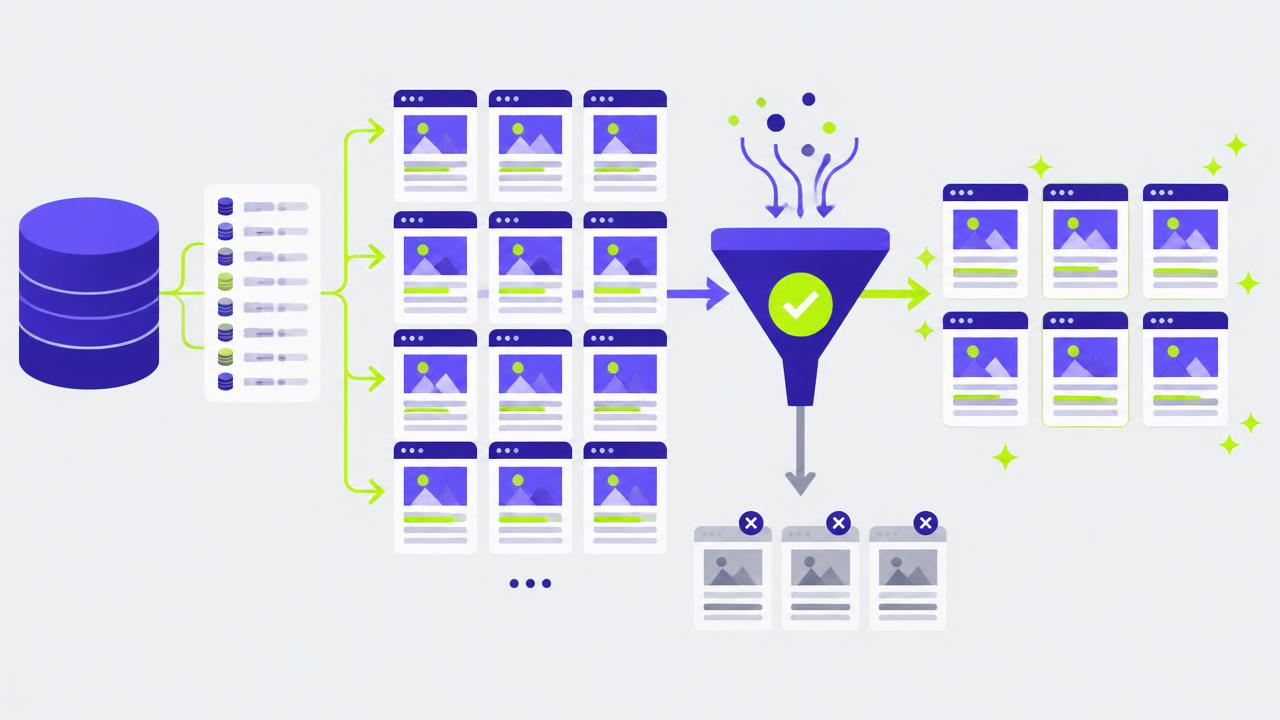
Programmatic SEO has a bad reputation earned by a decade of thin, templated pages. The technique itself is sound: if you hold structured data that answers a family of real queries, generating a page per entity is simply efficient publishing. The failures come from generating pages where the data is thin or the demand is imaginary.
The test a template must pass
Take one generated page. Remove the boilerplate. What remains should be genuinely useful and genuinely specific. If the residue is a name, a number and three sentences with a variable substituted, the template is not ready — it will produce pages that satisfy nobody and dilute the section they sit in.
A template is a promise repeated thousands of times. Make sure it is a promise you can keep.
Demand validation comes first
| Check | Threshold | Action if failed |
|---|---|---|
| Query volume for the entity | Any measurable demand | Exclude from generation |
| Data completeness | All required fields present | Hold until data exists |
| Uniqueness of content | Substantial non-boilerplate share | Enrich or exclude |
| Competing results quality | Beatable with your data | Deprioritise |
Publish in waves
Generating fifty thousand pages in one deployment gives you no feedback loop and a large index risk. Launch the strongest few hundred, wait for indexation and impressions, then read what happened: which pages got indexed, which got impressions, which got clicks. Each wave should improve the template before the next one goes out.
Internal linking is mandatory at scale
Generated pages orphaned behind a sitemap file rarely get crawled properly. They need real navigation: category hubs, related-entity links between pages, and links from editorial content. Build the link graph as part of the generation, not as a later project.
Prune without sentiment
After two quarters, review the impressions per page. Pages with essentially none are not neutral - they consume crawl and weaken the section's overall quality assessment. Remove them or consolidate them into a page that covers several entities together. The remaining pages usually perform better afterwards, which surprises teams every time.
Related articles

Topical Maps: Turning Keyword Lists Into Territory
Search engines reward demonstrated coverage of a subject, not isolated pages. A topical map is the plan that turns scattered posts into an ownable territory.

Content Briefs That Make Freelancers Unnecessary to Manage
Editing a bad draft costs more than writing a good brief. Most teams keep choosing the expensive option.

Writing for AI Answer Engines Without Abandoning Search
Answer engines reward clarity, structure and verifiable claims. So did search, we just got away with less.