
Refreshing Decaying Content Without Losing Rankings
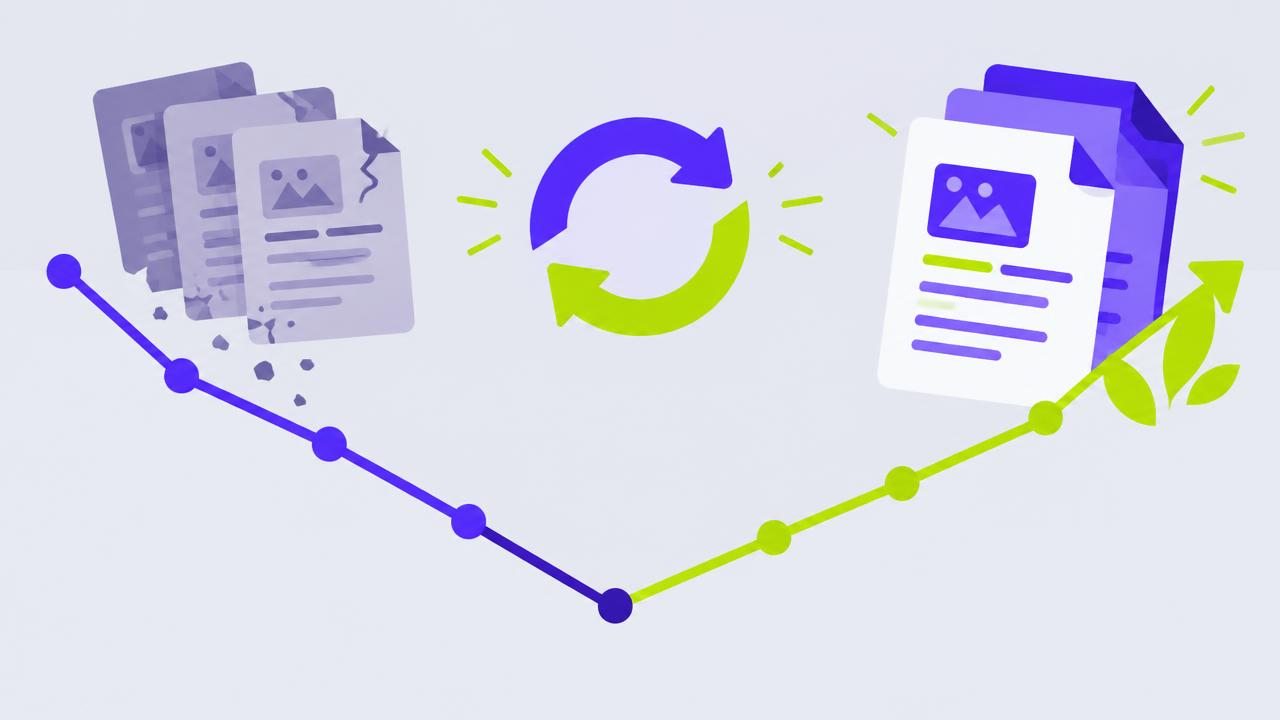
Every content library over two years old is losing traffic somewhere. That is not a failure of the original work; it is the normal consequence of a moving search landscape. The operational question is which declines to act on, and what action actually reverses them.
Start by separating decline from decay. A page that dropped 30% because its keyword lost 30% of its search volume has not decayed — demand moved. Check the query-level impression trend before doing anything. If impressions are flat and clicks fell, you lost position or lost the click to a SERP feature. If impressions fell too, the market changed and a rewrite will not bring it back.
The three real causes
Intent shift
The results page for a query changes composition: what was ten blog posts is now three product pages, a video carousel and two forum threads. Your informational article is now the wrong document type. No amount of polishing fixes this. The response is either to change the page type to match, or to accept the loss and redirect the topic elsewhere.
Competitor depth
Someone published a more complete answer. This is the most common cause and the most fixable. The diagnostic is a section-level comparison: pull the subheadings of the top three results and compare them against yours. The gaps are usually obvious — they cover pricing, you do not; they answer the follow-up question, you stop at the definition.
Internal cannibalisation
You published something newer that competes. Search Console will show two URLs alternating for the same query, each ranking worse than the original did alone. This is self-inflicted and the fix is consolidation.
Triage before treatment
| Situation | Action | Effort |
|---|---|---|
| High value, lost position, gaps vs competitors | Targeted refresh | Medium |
| Two pages competing for one query | Merge and 301 the weaker | Low |
| Intent shifted to a different page type | Rebuild as the right type, or retire | High |
| Low value, no impressions for 12 months | Delete or noindex | Low |
| Declining impressions, stable position | Leave it alone | None |
Most refresh programmes fail because they rewrite pages that were never going to recover, and skip the merges that would have worked in an afternoon.
How to refresh without breaking what worked
The riskiest thing you can do to a page that still ranks for fifty long-tail queries is rewrite it wholesale. Those rankings come from specific sentences, and a clean rewrite deletes them invisibly.
Work at section level instead. Export the page's queries from Search Console, group them by which section of the page answers them, and identify which groups lost position. Expand and update only those sections. Add the missing sections your competitors have. Leave the rest of the prose alone even if the style feels dated.
Keep the URL. Changing a URL to something prettier during a refresh introduces a redirect, resets some accumulated signals and adds a variable that makes the result unmeasurable. Refresh the content in place; if the slug is genuinely wrong, change it in a separate release weeks later.
Merging done properly
When two pages compete, pick the winner on backlinks first and traffic second — links are harder to replace than words. Move the unique, valuable sections of the loser into the winner, 301 the loser to the winner, and then update every internal link that pointed at the old URL. That last step is the one teams skip, leaving the site pointing at a redirect chain and diluting the benefit.
Timing and measurement
Recrawl is fast; re-evaluation is not. Expect four to eight weeks before a refresh shows its real effect, longer on low-authority domains. Record the date of every refresh in a simple log alongside the page URL, and compare the 28 days before to the 28 days starting four weeks after. Without that log, refresh work becomes unattributable and it is always the first budget line cut.
A reasonable cadence for a library of 200-500 pages is a monthly cycle: audit for decay, triage twenty pages, act on eight, log them all. That is enough to hold total organic traffic flat even in a competitive category, before any new publishing is counted — which is the honest way to describe what a refresh programme buys you.
Related articles

Topical Maps: Turning Keyword Lists Into Territory
Search engines reward demonstrated coverage of a subject, not isolated pages. A topical map is the plan that turns scattered posts into an ownable territory.

Content Briefs That Make Freelancers Unnecessary to Manage
Editing a bad draft costs more than writing a good brief. Most teams keep choosing the expensive option.

Writing for AI Answer Engines Without Abandoning Search
Answer engines reward clarity, structure and verifiable claims. So did search, we just got away with less.