
Meta Ads Account Structure in 2026: Consolidate, But Not Blindly
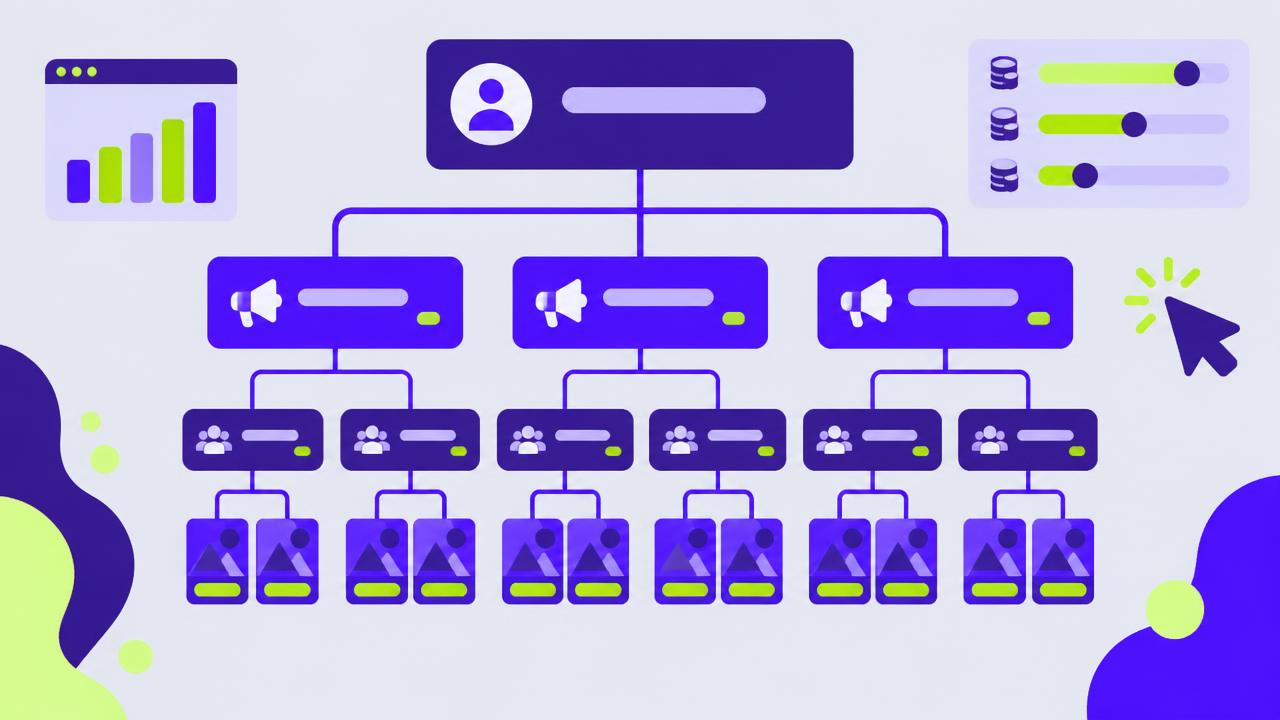
Every account audit starts the same way: forty-one active ad sets, nine campaigns, and a spend distribution where the bottom thirty ad sets share 12% of the budget. The operator built it over eighteen months, one reasonable decision at a time. The result is an account that cannot learn, because no single optimisation unit accumulates enough data to exit the learning phase.
Consolidation fixes this, and it has been the standard recommendation for years. But applied mechanically it causes its own damage. The useful skill is knowing which dimension to consolidate on.
The arithmetic that drives everything
Meta's delivery system optimises per ad set. It needs a minimum volume of the optimisation event to build a reliable model — roughly 50 conversions per week per ad set is the widely used threshold, and while the exact number varies, the shape of the rule is real. Below that, delivery behaves erratically: cost per result swings, and each edit resets the process.
So the first question is not philosophical. It is: how many ad sets can my budget support?
| Weekly budget | Target CPA | Weekly conversions | Max viable ad sets |
|---|---|---|---|
| $3,500 | $35 | 100 | 2 |
| $14,000 | $35 | 400 | 8 |
| $14,000 | $140 | 100 | 2 |
| $70,000 | $70 | 1,000 | 20 |
Two implications follow immediately. Small accounts should be nearly fully consolidated — one campaign, one or two ad sets, many creatives. And optimising for a higher-funnel event (add-to-cart rather than purchase) is a legitimate way to buy more learning volume when purchase counts are thin, provided you accept the quality trade-off and monitor downstream conversion rates.
What deserves its own campaign
The rule that holds up across accounts: separate on economics, not on audience. Two audiences with the same target CPA and the same margin belong in one ad set with broad targeting; the algorithm will find the split better than you will. Two products with a 4x difference in contribution margin do not belong together, because a single bid target cannot serve both.
Concretely, separate when any of the following is true:
- Different unit economics. A $40 subscription and a $900 enterprise plan need different bids and different creatives.
- Different geography with different costs. Mixing a $6 CPM market with a $28 CPM market inside one ad set hands delivery to the cheap market regardless of value.
- Different measurement windows. A product with a same-day purchase cycle and one with a 30-day cycle cannot share an optimisation event honestly.
- Budget protection. When a business line must receive spend for strategic reasons, giving it its own campaign is a financial control, not an optimisation choice.
Audience segmentation is a hypothesis about people. Campaign separation is a statement about money. Only the second one justifies fragmenting your budget.
Broad vs interest targeting, revisited
Broad targeting has become the default for good reasons: the signal in the creative and the conversion feed now outperforms manual interest selection in most categories. But "broad works" is not universal. It relies on having enough conversion volume for the model to find the pocket of people who convert. In a low-volume account, or one selling into a genuinely narrow niche — veterinary practice software, industrial fasteners — interest and lookalike constraints still earn their keep by reducing the search space.
A practical compromise: run broad as the primary ad set, and keep one constrained ad set as an insurance policy. If broad degrades after a creative refresh or a tracking disruption, you have a functioning alternative rather than a cold start.
The testing campaign question
Creative testing inside a scaling campaign contaminates it. New ads reset delivery, absorb budget from proven performers, and make week-on-week comparisons meaningless. Keep a separate testing campaign with a fixed budget — commonly 15 to 25% of total spend — and a lower bar for success. Its job is to produce candidates, not profit.
Promotion rule: define in advance what moves an ad from testing to scaling. A typical rule is 1,000+ impressions, a hook rate above the account median and a CPA within 130% of target. Written rules prevent the weekly argument about whether a promising ad deserves another chance.
Costing a restructure honestly
Restructures are not free. Merging ad sets resets learning, and the first seven to fourteen days typically show worse efficiency than the structure you are replacing. Teams abandon good restructures on day four constantly.
Plan for it: pick a low-seasonality window, do the change in one move rather than incrementally, communicate the expected dip to whoever reads the dashboard, and commit to a full two weeks before judging. If your business cannot absorb two weeks of variance, run the new structure in parallel at 20% of budget instead — it takes longer but it removes the political risk that kills the project.
A default structure worth starting from
For an account spending $20,000 to $100,000 a month with one core offer: one prospecting campaign with one broad ad set and eight to twelve live creatives; one retargeting campaign with a single consolidated audience and a frequency cap; one testing campaign at 20% of budget; and, if applicable, one separate campaign per product line with materially different margin. That is three to five campaigns total.
It will look sparse next to the account you have. That is the point — the structure exists to concentrate signal, and every extra box you draw divides it.
Related articles

Match Types and Negatives: Steering Broad Without Bleeding
Broad match is a proposal, not a promise. Negatives are how you answer it.

Retargeting Works Until It Annoys: Setting Frequency Honestly
Retargeting does not create demand, it closes it. Budget it like a closing tool and cap it like one.

Video Ads That Earn the First Three Seconds
The first three seconds decide whether the other twenty-seven exist. Most budgets are spent producing the part nobody reaches.